Giants and Dwarfs - The Outer Solar System


Event details
- Location
- CODE Studio
- Date
- Organizer
- CODE Center of Digital Experiences
Related events
-

-

-

-

-
-


Discover the secrets of the outer solar system, the world of the "giants"—Jupiter, Saturn, Uranus, and Neptune—and travel with us to the Oort Cloud, where the story of the unique dwarf planet Pluto will be revealed.
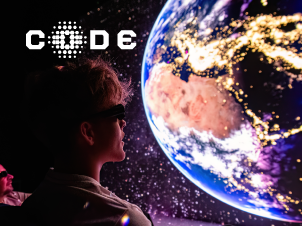
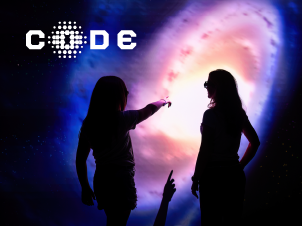
The Studio's 180-degree guided projection allows you to enter a 3D space where you can fly among the stars, discover planets, and peer into the depths of galaxies— all based on real-time scientific data and supplemented with interactive visualizations. During the screening, the celestial bodies of the solar system, the mysterious world of pulsars, and the structure of galaxies will be revealed in a level of detail that has rarely been seen before.


Our solar system consists of eight planets and can be divided into two large empires: the Inner and Outer Solar System. This is where the world of the "giants" begins, where Jupiter is not only large, but also a system-forming force—its storms, internal heat, and brutal magnetic field are a complete cosmic machine. Saturn's rings show that beauty is sometimes nothing more than the delicate order of billions of pieces of ice, while its moons hide separate worlds. Uranus tilts sideways as it "rolls" around the Sun, while Neptune is a distant blue laboratory where dynamics rage even in the darkness.
At the boundary between the two regions stretches the asteroid belt; moving outward, we enter the outer reaches of the Kuiper Belt, where the myth of the “ninth planet” ultimately transforms into a dwarf-planet story. Here Pluto finds its rightful place, and here the strangely shaped, icy worlds emerge—as if the Solar System were keeping its own archive in the outer darkness. And just when we might think it has all come to an end, the ultimate frontier appears: the Oort Cloud, the distant reservoir of comets, where the history of the Solar System becomes more conjecture than charted map.
Behind the scenes, state-of-the-art technology is at work: every projection is based on scientifically verified data, including data from the James Webb Space Telescope, the Voyager probes, and the latest astronomical research. During the Xbox controller-managed presentation, you can always see the planets in their current positions—where it is nighttime, the sky is dark in the image, and you can even observe the Aurora Borealis in real time in the northern hemisphere of the Earth. Part of the experience is that you can "visit" the International Space Station, following its trajectory and observing how it orbits our planet.

The 3D glasses and spatial sound provide such a realistic experience that you feel as if you are actually floating in space, while discovering the structure and infinite dynamics of the universe.
Each presentation is led by an information trainer who helps you discover the infinite faces of the world with exciting stories and interesting facts. This experience is both inspiring and thought-provoking: it helps us get closer to the vast world of which we are a small part.